Building a functional and comprehensive garage home gym on a budget is entirely possible and highly rewarding, even with a limited investment of under $1500. With over a decade of experience in home fitness equipment, I can confirm that strategic equipment choices, cost-saving strategies, and smart setup tips enable you to create an effective workout haven without breaking the bank. This guide outlines how to transform your garage into a powerhouse of fitness, focusing on versatility and quality within your chosen price point.
Building Your Ideal Home Gym: A Comprehensive Guide
A home gym is a dedicated space equipped with various fitness tools, allowing individuals to complete workouts comfortably and privately at home. Setups range from minimalist resistance band kits to elaborate multi-station systems, varying based on personal fitness goals and available resources.
Exercising at home offers unparalleled flexibility, saving travel time and eliminating monthly membership fees. It provides a private, distraction-free environment where you can customize your workout schedule and equipment. In an era prioritizing health and safety, a personal gym offers peace of mind. Common home gym types include bodyweight setups, strength-oriented spaces with free weights, cardio-centric areas, or comprehensive full-body training zones.
Classifying Home Gyms by Price Range
Understanding different investment levels helps you plan effectively. Prioritize versatility and quality within your chosen price point, regardless of your budget.
Budget Home Gym (Under $500)
A budget-friendly home gym maximizes utility from minimal investment, making fitness accessible. This category suits beginners, those with limited space, or individuals focused on bodyweight and lighter strength training.
- Pros: Extremely affordable, low barrier to entry, highly portable equipment.
- Cons: Limited capacity for heavy lifting, fewer specialized machines, requires creativity to maximize workouts.
- Who it’s for: Fitness newcomers, apartment dwellers, individuals prioritizing flexibility and foundational strength.
- Suggested Items: Resistance bands, a jump rope, a light set of adjustable dumbbells (e.g., 5-25 lbs), a doorframe pull-up bar, a stability ball, and a yoga mat. These items offer a wide range of exercises for a full-body workout.
Mid-Range Home Gym ($500-$1500)
A mid-range budget significantly expands capabilities for more substantial strength training and a broader array of exercises. This level is perfect for intermediate lifters or those committed to compound movements and progressive overload, offering excellent value.
- Pros: Provides access to compound lifts, better durability, more versatile equipment than basic setups.
- Cons: Still requires strategic purchasing to maximize the budget, may need upgrades for advanced training.
- Who it’s for: Intermediate fitness enthusiasts, individuals aiming for muscle gain and strength development, those with a dedicated garage space.
- Suggested Items: A sturdy squat stand or half rack, a quality Olympic barbell (consider used to save costs), a set of bumper plates (often found at competitive prices used), an adjustable bench (flat/incline/decline), and a heavier set of adjustable dumbbells or a selection of kettlebells. This combination allows for major lifts like squats, bench presses, and deadlifts.
High-End Home Gym (Over $1500)
A high-end home gym represents a significant investment, delivering a comprehensive, durable, and feature-rich training environment comparable to commercial facilities. This category is for serious lifters, competitive athletes, or anyone seeking a long-term, no-compromise fitness solution with ample space.
- Pros: Commercial-grade durability, extensive exercise variety, advanced features, often includes specialized equipment.
- Cons: High initial cost, requires substantial dedicated space.
- Who it’s for: Advanced lifters, personal trainers, anyone seeking a complete, professional-grade home workout experience.
- Suggested Items: A full power rack with numerous attachments, a premium Olympic barbell and extensive weight plate sets, a functional trainer or cable machine, advanced cardio equipment (like a Concept2 rower or Assault Air Bike), specialized strength machines (e.g., leg press), and comprehensive storage solutions. This setup often includes professional-grade gym flooring and smart fitness tech.
Top Essential Home Gym Equipment for a Budget Garage Setup
|
Our Picks for the Best Home Gym in 2026
As an Amazon Associate I earn from qualifying purchases.
|
||
| Num | Product | Action |
|---|---|---|
| 1 | TRX All-In-One Home Gym System – Complete Suspension Training Kit for Strength Training, HIIT & Full-Body Workouts at Home or Outdoors, Includes Indoor & Outdoor Anchors |

|
| 2 | MQRW Push Up Board,Home Gym,Portable Exercise Equipment,Pilates Bar and 20 Fitness Accessories with Resistance Bands and Ab Roller Wheel,Full Body Workout at Home |
|
| 3 | 6-Tier Home Gym Storage Rack with Wheels, Dumbbell Weight Rack and Yoga Mat Organizer, Multi-Purpose Gym Equipment Storage Stand for Home Gym Accessories |
|
| 4 | Resistance Bands for Working Out, 5-Pack Elastic Loop Exercise Bands for Strength Training Stretching, Home Gym Equipment for Pilates Yoga Physical Therapy, Leg Glute Arm Workout Kit for Women Men |
|
| 5 | Sunny Health & Fitness Mini Stepper for Exercise at Home, Stair Step Workout Machine with Resistance Band and Over 300lb Weight Capacity, Optional Twist Motion and Free SunnyFit App Connection |
|
| 6 | Adjustable dumbbell set,20/35/45/55/70/90lbs Free Weights set with upgraded nut, 5 in 1 Weight Set Used as Kettlebells, Barbell, Push up Stand, Fitness Exercise for Home Gym Suitable Men/Women |
|
| 7 | Ally Peaks Pull Up Bar for Doorway | Thickened Steel Max Limit 440 lbs Upper Body Fitness Workout Bar| Multi-Grip Strength for Doorway | Indoor Chin-Up Bar Fitness Trainer for Home Gym Portable |
|
| 8 | VINSGUIR Ab Roller Wheel, Abs & Core Workout Equipment for Home Gym with Knee Pad Accessories, Abdominal Wheel for Full-body Strength Training |
|
| 9 | Yoleo Adjustable Weight Bench for Full Body Workout; Foldable Bench Press Bench of Home Gym Strength Training; Incline Decline Flat Utility Workout Bench with Quick Folding& Fast Adjustment (Black) |
|
| 10 | Adjustable Ropeless Battle Ropes for Home Gym for Men & Women,Adjustable Weights Cordless Battle Ropes with Storage Bag,Multifunctional Strength Training for Home & Gym |
|
Building an effective garage gym on a budget means focusing on versatile, durable equipment that offers the most value. These foundational pieces allow for a wide array of exercises and progressive overload.
Squat Rack or Stand
A squat rack or stand is often the centerpiece of any serious home gym, even on a budget. It provides essential safety for heavy compound lifts like squats, bench presses, and overhead presses, often incorporating a pull-up bar. For budget-conscious builders, models like the Titan T-2 Series Rack or the REP PR-1100 are recommended for their sturdy construction and affordability. These options offer sufficient weight capacity and adjustability for most home users, ensuring safe heavy lifting without a spotter.
Adjustable Weight Bench
An adjustable weight bench is crucial for its versatility, transforming workout capabilities. It sets to flat, incline, or decline positions to target different muscle groups during presses, rows, and flyes. Beyond traditional weightlifting, a sturdy bench can also be used for box squats, step-ups, and various core exercises. Brands like Major Fitness and REP Fitness offer adjustable benches providing excellent stability and multiple adjustment angles for under $300, making them a wise investment.
Barbell & Weight Plates
Investing in a quality Olympic barbell is highly recommended, even for a budget setup. Cheaper, generic barbells often bend, have poor knurling, and sleeves that seize up, leading to frustration and potential injury. Options like the Rogue Echo Bar 2.0 or CAP OB-86 offer excellent durability and performance at a more accessible price point. For weight plates, steel plates are generally cheaper per pound and suffice for powerlifting movements, while bumper plates are ideal for Olympic lifts where dropping the bar is common. Always look for used plates on platforms like Craigslist or Facebook Marketplace for significant savings.
Adjustable Dumbbells
Adjustable dumbbells are a major upgrade for budget and space-conscious home gym owners, replacing an entire rack of fixed dumbbells with a single compact pair. This allows for a wide range of exercises, from bicep curls to lunges, without cluttering your garage. Brands such as PowerBlock, NordicTrack Select-A-Weight, and Core Home Fitness offer reliable adjustable dumbbell sets that provide excellent value and convenience. While the initial cost might be higher than a single pair of fixed dumbbells, the long-term savings in space and money are substantial.
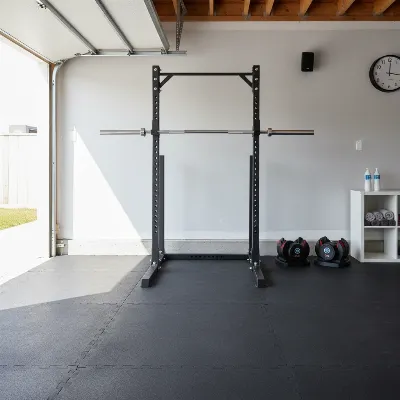 A well-organized budget garage home gym with essential equipment like a squat stand, adjustable dumbbells, and horse stall mats on the floor.
Resistance Bands
Resistance bands are incredibly versatile, portable, and one of the most cost-effective additions to any home gym. They can be used for warm-ups, stretching, mobility work, rehabilitation, and adding progressive resistance to bodyweight exercises like push-ups or pull-ups. Available in various resistance levels, a set of loop bands can provide a full-body workout or supplement your primary lifting routine, making them an indispensable tool for any budget.
Gym Flooring
Protecting your garage floor and equipment, while providing a stable, cushioned surface, is essential. For a budget-friendly and highly durable solution, horse stall mats are unmatched. These 3/4-inch thick rubber mats, typically found at Tractor Supply or local feed stores, withstand heavy abuse. They cost significantly less than specialized gym flooring and offer superior protection against drops and impacts. Be aware that they might have a strong rubber smell initially, which dissipates over time with proper ventilation.
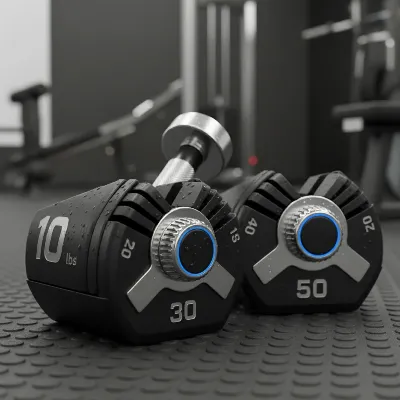 Close-up of a pair of adjustable dumbbells, highlighting their space-saving design and various weight settings.
Cardio (Jump Rope / Air Bike)
Cardiovascular health is crucial, and you don’t need an expensive treadmill for an effective cardio workout. A high-quality jump rope is an incredibly efficient and portable tool for burning calories and improving endurance, costing only a fraction of larger machines. For a more intense, full-body cardio option on a budget, a used or entry-level air bike can be an excellent investment. These machines provide a challenging workout that engages both upper and lower body, making them a versatile addition.
Comparison Table of Essential Budget Home Gym Items
| Equipment | Typical Budget Price Range | Key Benefits | Considerations |
|---|---|---|---|
| Squat Stand/Half Rack | $250 – $600 | Safety for compound lifts, built-in pull-up bar | Footprint, weight capacity, potential for attachments |
| Adjustable Bench | $100 – $300 | Versatility for various exercises (flat/incline/decline) | Stability, weight capacity, ease of adjustment |
| Olympic Barbell | $150 – $300 (new) | Foundation for strength training, compound movements | Bar quality (steel/finish), knurling, whip |
| Weight Plates | $1-$2/lb (new), < $1/lb (used) | Progressive overload, customizable resistance | Bumper vs. steel, condition if buying used |
| Adjustable Dumbbells | $200 – $400 (pair) | Space-saving, replaces multiple dumbbell sets | Durability, ease of adjustment, max weight |
| Resistance Bands | $20 – $50 (set) | Versatile, portable, assists/adds resistance | Material quality, range of resistance levels |
| Horse Stall Mats | $50 – $70 per 4×6′ mat | Floor protection, shock absorption, good grip | Weight, initial odor, installation |
| Jump Rope | $10 – $30 | Highly effective cardio, portable | Handle comfort, rope material and length |
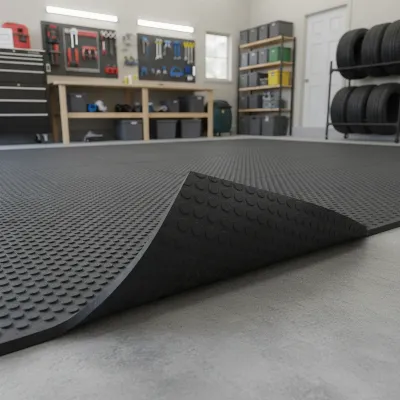 Durable horse stall mats laid out as gym flooring in a garage, protecting the concrete.
Detailed Guide to Buying a Home Gym
Building a garage home gym on a budget requires a strategic approach. Plan meticulously before making purchases to ensure every dollar is spent wisely.
Define Your Needs and Goals
Start by clearly identifying your fitness objectives. Are you primarily focused on strength training, muscle building, weight loss, or cardiovascular endurance? Do you have specific movements or lifts you want to perform, such as powerlifting, Olympic lifting, or bodyweight exercises? Your goals will dictate equipment prioritization. For example, a powerlifter needs a sturdy rack, barbell, and plates, while someone focused on cardio might invest in an air bike and jump rope first.
Set Your Budget
Be realistic about how much you can spend, both initially and for future additions. Building a home gym is an investment that saves money long-term by eliminating gym memberships. Consider the initial outlay versus the long-term financial benefits. It’s often better to buy fewer, higher-quality, versatile pieces that fit your budget than many cheap, flimsy items that quickly need replacement.
Assess Your Space
Before buying any equipment, thoroughly measure your garage. Consider its total dimensions, ceiling height, and any existing obstacles. If you need to park a car in the garage, factor in movable or foldable equipment. Maximize vertical space with wall-mounted storage for smaller items. Ensure enough room for safe movement around all equipment, especially for dynamic exercises like deadlifts or overhead presses.
Key Factors to Consider When Selecting Home Gym Equipment
- Material Quality & Durability: This is paramount, especially for items like squat racks and barbells where safety is a concern. Look for heavy-gauge steel in racks and quality finishes on barbells that resist rust and wear. Durable equipment may cost a little more upfront but will last much longer, saving money on replacements.
- Features & Versatility: Opt for multi-purpose equipment whenever possible. An adjustable bench is far more versatile than a flat bench, and a squat rack with a pull-up bar offers more exercise options than a standalone squat stand. Adjustable dumbbells are a prime example of versatility and space-saving.
- Size & Footprint: In a garage, space is often at a premium. Prioritize compact solutions, wall-mounted storage, and foldable equipment. Adjustable dumbbells and resistance bands are excellent for small spaces.
- Adjustability: Ensure equipment can be adjusted to fit different users and accommodate various exercises. Racks with closely spaced holes for J-hooks and safety pins, and benches with multiple incline/decline settings, are highly beneficial.
- Brand & Supplier Reputation: Research brands known for quality, customer service, and good warranties. Read reviews from other home gym owners. While budget is key, some items are worth a slight premium for reliability and safety.
Where to Buy Home Gym Equipment
Finding the right equipment at the right price is a hunt.
- New Equipment: Reputable online fitness retailers like Rogue Fitness, REP Fitness, and Titan Fitness are excellent sources for specialized strength equipment. For more basic items like resistance bands, yoga mats, or lighter adjustable dumbbells, larger online marketplaces like Amazon can offer competitive pricing.
- Used Equipment: This is where significant savings can be made. Platforms like Craigslist and Facebook Marketplace are treasure troves for barbells, weight plates, benches, and even older squat racks. Local sporting goods stores (e.g., Play It Again Sports), garage sales, estate sales, and even university gym clear-outs can yield fantastic deals. When buying used, always inspect items for damage, rust, or wear before purchasing.
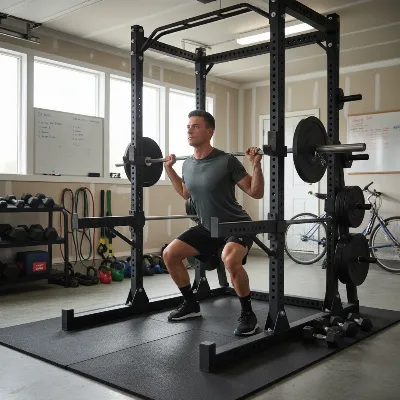 A person performing squats safely within a budget-friendly squat rack in a garage gym.
Conclusion
Building a complete garage home gym on a budget is an entirely achievable goal with the right mindset and strategic choices. By focusing on versatile, durable, and cost-effective equipment, you can create a personalized workout space that supports your fitness journey for years to come. The convenience, privacy, and long-term financial savings of a home gym far outweigh the initial planning and investment. Embrace the process, prioritize your core needs, and gradually expand your setup as your fitness evolves and your budget allows. Your ideal workout sanctuary is within reach.
What essential piece of equipment will you add to your budget garage gym first to kickstart your fitness transformation?
Frequently Asked Questions
Frequently Asked Questions
What is the minimum equipment needed for a garage gym?
For a truly minimalist garage gym, essential equipment includes resistance bands, a jump rope, and a set of adjustable dumbbells. These items are highly versatile, allowing for a comprehensive range of strength and cardio exercises, and are excellent for small spaces and tight budgets.
How much does it typically cost to set up a basic garage gym?
A basic yet effective garage gym, focusing on foundational strength and cardio, can be set up for approximately $500 to $1000. This budget typically covers a squat stand, an adjustable bench, a quality barbell, some weight plates, and essential flooring like horse stall mats.
Are adjustable dumbbells worth the investment for a home gym?
Absolutely. Adjustable dumbbells are a highly recommended investment for any home gym, especially on a budget or in limited space. They replace numerous pairs of fixed dumbbells, saving significant space and money while offering a wide range of weight options for progressive overload.
Can I really get a full-body workout with budget garage gym equipment?
Yes, you absolutely can achieve a full-body workout with budget garage gym equipment. By choosing versatile items like an adjustable bench, a squat rack, adjustable dumbbells, and resistance bands, you can perform exercises targeting every major muscle group, from compound lifts to isolated movements.
What are the best flooring options for a garage gym on a budget?
For a budget-friendly and durable flooring solution, 3/4-inch thick horse stall mats, readily available from feed stores like Tractor Supply, are highly recommended. They offer excellent protection for your floor and equipment against impacts and provide a stable workout surface at a fraction of the cost of specialized gym flooring.
Where can I find used gym equipment to save money?
To save money on gym equipment, explore local online marketplaces such as Craigslist and Facebook Marketplace. Check out used sporting goods stores like Play It Again Sports, local gym liquidation sales, and estate sales for potential deals on barbells, weight plates, and benches.
How to Build a Budget Garage Home Gym
Building an effective garage home gym on a budget requires strategic planning and smart equipment choices. Follow these steps to create your ideal workout space.
Clearly identify your fitness objectives, whether it's strength training, muscle building, or cardio. Your goals will dictate the type of equipment you prioritize, such as a sturdy rack for powerlifting or an air bike for cardiovascular endurance.
Determine how much you can spend initially and for future additions. It's better to invest in fewer, higher-quality, versatile pieces that fit your budget than many cheap items that will need frequent replacement.
Measure your garage's dimensions, ceiling height, and note any obstacles. Factor in space for parking if needed, and maximize vertical space with wall-mounted storage. Ensure ample room for safe movement around all equipment.
Prioritize equipment with high material quality and versatility, like heavy-gauge steel racks and adjustable benches. Look for multi-purpose items such as adjustable dumbbells and squat racks with pull-up bars to maximize exercise options and save space.
Buy new equipment from reputable online retailers like Rogue Fitness or REP Fitness for specialized items. For significant savings, explore used equipment on platforms like Craigslist, Facebook Marketplace, or local sporting goods stores, always inspecting items for damage before purchase.

Overall, some good ideas here for a budget garage home gym. I appreciate the focus on cost-saving strategies. However, I was hoping for a bit more detail on specific brands for the power rack suggestions. It felt a little vague in that section, making it harder to compare options directly. Still, it’s a solid starting point for anyone on a tight budget.
As someone with limited space and a desire to work out at home, this was exactly what I needed. The guide’s focus on essential items and smart setup tips made the whole process seem much less daunting. I’ve already started looking into a good quality resistance band kit, which was one of the first things mentioned for versatility. Thanks for the practical advice!
This was super helpful for planning my garage gym! I especially liked the emphasis on quality within a chosen price point, which is something I often struggle with when buying equipment. The advice on how to transform my garage into a fitness haven really resonated with me. I’m excited to finally get my setup going.
I’ve been wanting to set up a home gym in my garage for ages but always thought it would be too expensive. This guide really helped me see how to get started without spending a fortune. The tip about looking for versatile equipment like adjustable dumbbells instead of a full rack was a game-changer for my budget under $1500. My workouts have been so much more consistent now that I don’t have to drive to the gym.